Help Clinic Staff Talk with Patients About the PHQ-9

This tool is designed to help clinic support staff with answers to frequent questions they may hear from patients about the PHQ-9.

It’s best for support staff to have the opportunity to role play and practice before using the PHQ-9 with patients. It can also be helpful for support staff to keep this someplace where they can refer to it, as needed, when they get questions from patients.

Brief Pain Inventory (BPI)

The Brief Pain Inventory is a medical questionnaire used to measure pain, developed by the Pain Research Group of the WHO Collaborating Centre for Symptom Evaluation in Cancer Care.

Why Practice Collaborative Care?

Introduction:

This resource outlines the benefits of Collaborative Care and is designed to be shared with PCPs, stakeholders, and others looking to implement CoCM.

For a printable version, download the resource below. A printable PDF is available for download; however, please note that this document may not conform to the WCAG-2 accessibility standards.

Why Practice Collaborative Care?

Collaborative care (CoCM) is beneficial to primary care providers (PCPs) and their patients because it offers better
medical care, access to psychiatry experts, helps with challenging patient cases, and team collaboration.

Established Evidence Base

  • CoCM has a robust evidence base of over 80 randomized controlled trials and has been shown to be the best approach to treating depression in many populations and settings.
  • CoCM has a strong and expanding evidence base for its use with diverse behavioral health diagnoses such as anxiety, posttraumatic stress disorder, chronic pain, and dementia.

Better Medical Outcomes

  • CoCM is linked to better medical outcomes for patients with diabetes, cardiovascular disease, cancer, and chronic arthritis.
  • CoCM is recommended as a primary prevention strategy for cardiovascular events in patients without preexisting heart disease (Psychosomatic Medicine, 2014).

Help with Challenging Patient Cases

  • Many challenging cases likely have patients with untreated or undertreated behavioral health conditions. Behavioral health providers do the follow-up and intervention tasks that a busy PCP doesn’t have time to do, but make a big difference for patients.
  • PCPs are generally more satisfied working within an integrated behavioral health care program than within usual care (Family Community Health, 2015).

Faster Improvement

  • A 2016 retrospective study at Mayo Clinic found that the time to depression remission was 86 days in a CoCM program while in usual care it was 614 days.
  • Analysis of a large CoCM implementation found that early, intense intervention by the behavioral health provider was key to early improvement in patients with depression symptoms (Psychiatric Services, 2015).

It Takes a Team

  • CoCM uses an enhanced care team to provide a population based, treat-to-target approach to care. Through shared care planning, the team makes proactive changes in treatment to make sure that no patients fall through the cracks.
  • Only 30-50% of patients have a full response to the first treatment. That means 50-70% of patients need at least one treatment adjustment. Additional experts can help.

Comparing Collaborative Care to Usual Care

Introduction:

Compared with usual care, Collaborative Care has been shown to improve the effectiveness of depression treatment and lower total healthcare costs. This handout outlines those differences using data from the IMPACT trial.

A printable PDF is available for download; however, please note that this document may not conform to the WCAG-2 accessibility standards.

Comparing Collaborative Care to Usual Care

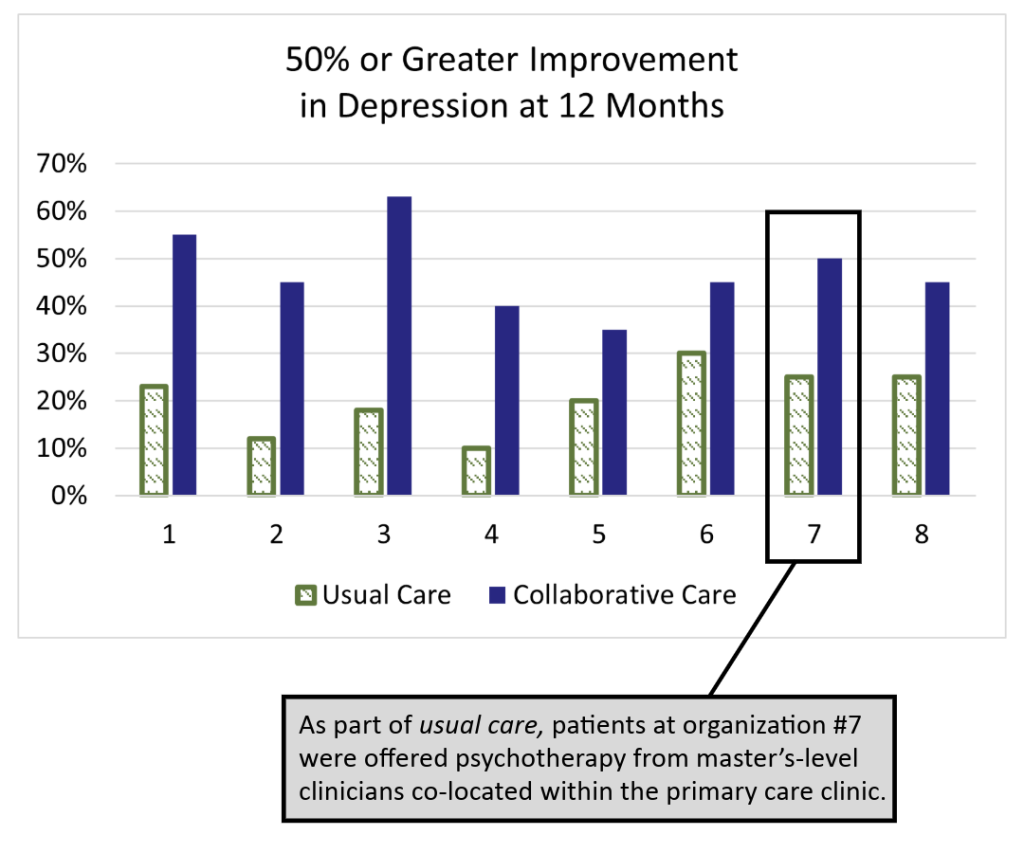
The IMPACT (Improving Mood: Providing Access to Collaborative Treatment) trial focused on depressed, older adults. Half were randomly assigned to receive the depression treatment usually offered by participating clinics, and half were randomly assigned to receive collaborative care. Collaborative care more than doubled the effectiveness of depression treatment and reduced total healthcare costs at the same time (JAMA, 2002).

A bar graph titled "50% of Greater Improvement in Depression at 12 Months" compares the effectiveness of Usual Care and Collaborative Care across eight different clinics. The y-axis represents the percentage, ranging from 0% to 70%. The x-axis lists clinics numbered from 1 to 8. For each group, there are two bars: a green bar with diagonal stripes representing Usual Care and a solid blue bar representing Collaborative Care. In all groups, Collaborative Care shows higher percentages of improvement compared to Usual Care. A box around the bars above "7" points to text reading, "As part of usual care, patients at organization #7 were offered psychotherapy from master's-level clinicians co-located within the primary care clinic.

Usual Care

50% of study patients used antidepressants at the time of enrollment, but were still significantly depressed.

70% of usual care patients received medication therapy from their PCP and/or a referral to specialty behavioral health.

Only 20% of patients showed significant improvements after one year, which matches national data for depression treatment in primary care.

Collaborative Care

On average, twice as many patients significantly improved. The difference was statistically significant in all eight healthcare settings. Why?

  • Patient-Centered Team Care
  • Population-Based Care
  • Measurement-Based Treatment to Target
  • Evidence-Based Care
  • Accountable Care

Evidence Base for Collaborative Care

A substantial body of evidence for Collaborative Care has emerged since its development at the University of Washington in the 1990s. Beginning with the seminal IMPACT Trial published in 2002, more than ninety randomized controlled trials and several meta-analyses show that Collaborative Care (CoCM) is more effective than usual care for patients with depression, anxiety, and other behavioral health conditions.

CoCM is also shown to be highly effective in treating co-morbid mental health and physical conditions such as cancer, diabetes, and HIV. The document summarizes several selected research, review, and practice-based articles that demonstrate Collaborative Care significantly improves patient lives.

PHQ-9 Visual Answer Aid

This answer aid is a visual representation of the PHQ-9 answer scale.  Behavioral Health Care Managers can use this resource alongside the PHQ-9 during screening to get a fuller understanding of how their patient is feeling.

Relapse Prevention Plan (Generic)

The purpose of a relapse prevention plan is to help the patient understand their own personal warning signs. These warning signs are specific to each person and can help the patient identify when their mental health is declining so they can get help sooner – before the symptoms get bad.

The other purpose of a relapse prevention plan is to help remind the patient what has worked for them before to help them feel better. The relapse prevention plan should be filled out by the Behavioral Health Care Manager and the patient together.

Tips for Discussing Trauma During an Initial Assessment

Trauma can increase the risk of health, social, and emotional problems. Despite the high prevalence of patients with a past history of trauma, few clinics or Collaborative Care teams have a protocol for addressing it. These three tips can help clinicians safely and effectively discuss the trauma history of their patients during their initial assessment.

Caseload Size Guidance for Behavioral Health Care Managers

This guidance will help health care organizations think about the questions to ask when determining an optimal caseload size for a Behavioral Health Care Manager. In addition, we provide two examples of different caseloads and considerations for scheduling patients.

Developing Protocols for Suicide Prevention in Primary Care

Introduction

Primary care clinics have a responsibility to provide effective and efficient suicide safe care that is accessible to all patients and staff. Developing a thoughtful and clear protocol and workflow for responding to suicidality in your primary care setting will empower staff to know how to act as well as help keep patients and staff safe.

The resource below contains information about screening and identification, conducting risk assessments, response and follow-up to suicide risk, as well as several additional resources. This information is intended to guide primary care clinics to refine existing protocol(s) for responding to patients presenting with suicidality or violent behavior in a primary care clinic.

printable PDF is available for download; however, please note that this document may not conform to the WCAG-2 accessibility standards.

Developing Protocols for Suicide Prevention in Primary Care

Primary care clinics have a responsibility to provide effective and efficient suicide safe care that is accessible to all patients and staff. Developing a thoughtful and clear protocol and workflow for responding to suicidality in your primary care setting will empower staff to know how to help keep patients safe. This information is intended to guide primary care clinics to refine existing protocol(s) for responding to patients presenting with suicidality in a primary care clinic.

Principles

All clinic staff are informed and supported

One-page workflows for responding to suicidal ideation should be easily accessible to all staff (not just the behavioral health staff or the clinic manager). These workflows should clearly outline when and how to respond, who to engage, and list internal and external resources. The 988 Suicide and Crisis Lifeline or other relevant emergency/crisis numbers are easily available. And staff are informed on how to contact the crisis response teams if available in your setting.

Collaboratively develop safety plans

A safety plan provides guidance and resources for the patient to reduce their risk of suicidal behavior. This is a collaborative document that includes holistic assessment paired with individualized intervention, as opposed to a safety contract, which is an agreement not to self-harm. There is no evidence that contracting for safety with a patient is effective at reducing suicides. In addition, contracts have no legal meaning and may give a false sense of security to a provider.

Take risk seriously

Primary care clinics should be screening patients to identify those at risk of suicide. Appropriate risk assessment and intervention should be completed for every patient identified with risk of suicide, every time.

Suicide Prevention Protocol Elements

The below sections provide descriptions of the key suicide prevention protocol elements, as follows:

  1. Screening and identification of suicide risk
  2. Asking about and assessing suicide risk level
  3. Responding to suicide risk level
  4. Follow up & next steps in care

1. Screening and identification of patients at risk of suicide

Any patient presenting for mental health or substance use treatment should be screened for thoughts of suicide with a validated screening tool. The PHQ9 question #9 is one example. It reads, “Have you been having thoughts that you would be better off dead or thoughts of hurting yourself in some way?”. When a patient scores positive for suicide risk, further information should be gathered.

Resource:

PHQ-9 Depression Scale  

2. Ask about and assess suicide risk level to determine next steps

To determine suicide risk level, a trained staff person should administer a validated screening tool like the Columbia-Suicide Severity Rating Scale (C-SSRS), Ask Suicide-Screening Questions (ASQ) and/or the Suicide Assessment Five-Step Evaluation and Triage (Safe-T). Providers should be trained to communicate with patients who are suicidal in a calm, curious, and caring manner. Validated tools when combined with clinical judgement can help determine levels of risk and aid in making clinical decisions about care.

In general, suicide risk level can be grouped into two categories:

Non-Acute Risk           

Imminent risk of completing suicide is not identified; indicates the patient can safely continue treatment in primary care with appropriate intervention.

Acute Risk

Imminent risk of completing suicide is identified; indicates patient should be under safe observation until a crisis response team completes an evaluation or patient is taken to an Emergency Department for potential hospitalization.

Levels of risk can be classified differently depending on the validated tool used. Some tools, like the C-SSRS or SAFE-T assign “high”, “moderate” or “low” values influenced by modifiable risk factors and protective factors. Classifications like these support interventions that are responsive to patient risk level.

Resources: 

3. Responding to suicide risk level

Non-Acute Risk Interventions: If risk is non-acute, the next step is to develop a collaborative safety plan. This is an important clinical component of treating a patient in an outpatient setting. Even when a patient is experiencing passive suicidal ideation, a safety plan should be done because suicide risk is not fixed and can change over time. Safety planning should address risk factors that can be modified, including limiting access to lethal means.

Acute Risk Interventions: If risk is acute, the provider should have a direct conversation about next steps for maintaining the patient’s safety. A clinic staff member should remain with the patient until the patient is evaluated by a crisis response team or in safe transport to an Emergency Department. Clinic staff should be trained on how to coordinate and provide relevant chart notes for the referral. A plan should be in place for appropriate action if a patient refuses care or leaves the clinic against medical advice (AMA). This may include contacting a crisis response team or the police.  

Resource(s):

4. Follow up & next steps in care

The clinic should have a clear process to follow up with patients who have presented with suicidal risk. This includes clear guidelines on how to regularly track, follow up on and review safety plans with patients. Staff should be trained in where to find completed plans in the EHR.

For patients who receive further evaluation by a crisis response team or Emergency Department, the primary care clinic should have a plan for coordinating care, including who is responsible for documenting and communicating evaluation outcomes and patient care plan with the team.

The clinic should offer support and follow up to staff who may be impacted by a patient treated for suicide risk or who dies by suicide.

Resource(s):