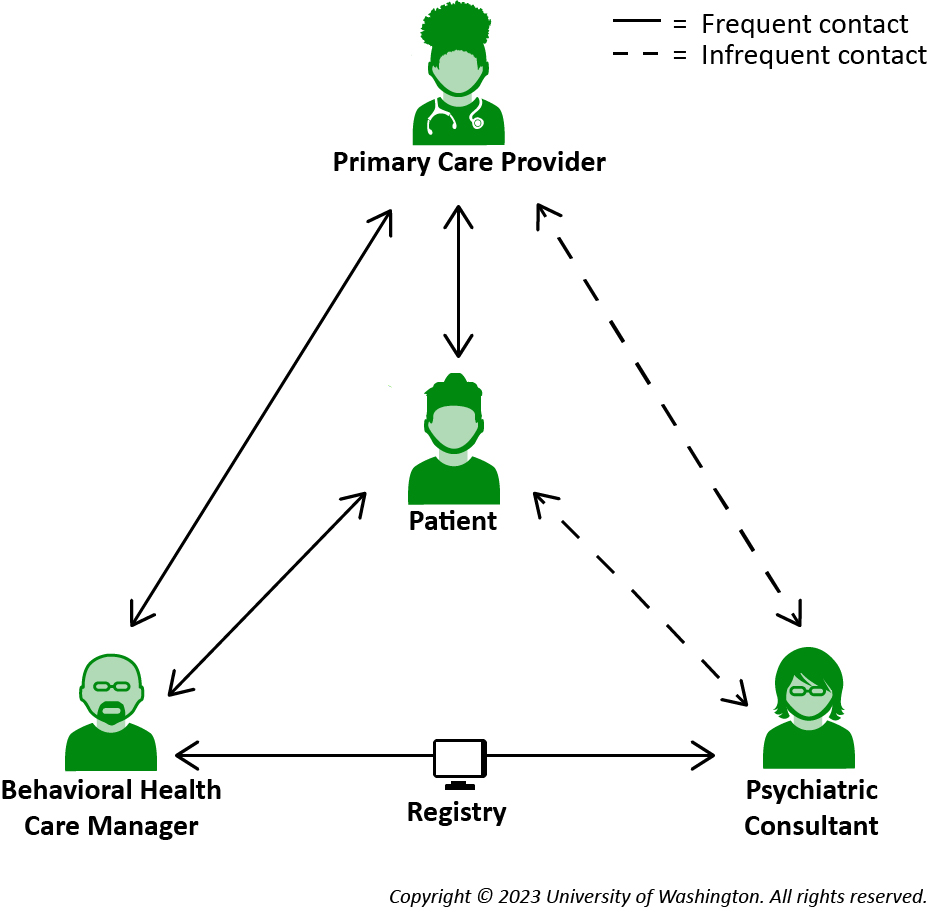
The Behavioral Health Care Manager is responsible for coordinating and supporting mental health care within the clinic and for coordinating referrals to clinically indicated services outside the clinic. The Behavioral Health Care Manager may provide evidence-based treatments or work with other mental health providers when such treatment is indicated.
The job description below provides a comprehensive list of the duties and responsibilities required of a Behavioral Health Care Manager.
The Psychiatric Consultant supports the prescribing medical provider and Behavioral Health Care Manager in treating patients with behavioral health problems. They will typically consult with the Behavioral Health Care Manager on a weekly basis to review the treatment plan and provide treatment suggestions for patients who are new or not improving as expected.
The resource below includes a PDF of a comprehensive description of the duties, responsibilities, resource requirements and typical workload of a Psychiatric Consultant.
For psychiatrists considering future roles in integrated care systems, it is important to clarify malpractice liability when providing advice about care for patients for whom the psychiatrist may not be the primary prescriber. This resource document provides background information on medical malpractice cases, defines the doctor-patient relationship, distinguishes the different forms of consultation offered to primary prescribers, describes the duty of the psychiatrist across the spectrum of roles on a patient care team, and, finally, makes recommendations to reduce the risk of malpractice issues.
It is important to clarify malpractice liability when providing care advice to patients where the psychiatrist may not be the primary prescriber. An example disclaimer regarding EMR reviews is below. Pairing this information with the name and contact information of the Psychiatric Consultant makes it easy to facilitate communication about recommendations. To the AIMS Center’s knowledge, this type of disclaimer has not been tested in a court case.
“The treatment considerations and suggestions in this case review are based on consultations with the patient’s Behavioral Health Care Manager and a review of information available in the care management tracking system. I have not personally examined the patient. All recommendations should be implemented with consideration of the patient’s relevant prior history and current clinical status. Please feel free to call me with any questions about the care of this patient.”
An example of a Psychiatric Consultant services agreement between a Community Mental Health Center and a Federally Qualified Health Center for organizations that may be interested in contracting for Psychiatric Consult services.
Please note: Contract language and template example is provided with permission from Valley Cities Behavioral Health Care.
Primary care providers (PCP) identify and engage patients in collaborative care, make diagnoses, and treat patients. The resource below describes the role of the PCP in more detail.
A printable PDF is available for download; however, please note that this document may not conform to the WCAG-2 accessibility standards.
The Role of the Primary Care Provider in Collaborative Care
The role of the primary care provider (PCP) in Collaborative Care (CoCM) is to oversee all aspects of a patient’s behavioral health care, including encouraging the patient’s participation, prescribing medications, and making referrals to specialty mental health care when needed. PCPs work in close collaboration with the patient’s behavioral health care manager (BHCM) and psychiatric consultant. This is summarized below.
Collaborative Care Team
Identifies and Engages
Introduces Collaborative Care to a patient
Acquires informed patient consent
Initiates a warm connection to a BHCM
Makes Diagnosis
Formulates using validated screeners, exams, and history
Works with care team to diagnose complex behavioral health conditions
Observes over time and adjusts diagnosis as appropriate
Treats
Works with care team and patient to develop a treatment plan
Works with care team to implement treatment and make treatment adjustments
Prescribes medications as needed
Addresses safety concerns
Monitors physical health and potential medication interactions
The Clinic Implementation Team Lead facilitates implementation and leads the Clinic Implementation Team (CIT). The CIT is created when a medical practice is planning to implement Collaborative Care. The document below outlines the CIT Leads’ key responsibilities, as well as the personal and professional characteristics that are most desirable in this role.
The Primary Care Provider (PCP) Champion plays a key role on the Clinic Implementation Team (CIT). The CIT is created when a medical practice is planning to implement Collaborative Care. This document outlines the PCP Champion’s key responsibilities with the team and their PCP colleagues, as well as the personal and professional characteristics that are most desirable in the role.